Gardeners with shaded yards often struggle to find ornamental grasses that don't require full sun. However, a surprising number of grasses, sedges, and grass-like perennials are naturally adapted to low-light conditions, offering texture, movement, and year-round interest beneath trees, along fences, or in woodland borders.
Unlike traditional lawn grass, which demands regular mowing, fertilizing, and weeding, ornamental grasses grow in tidy clumps or bunches, produce attractive flower spikes, and require minimal upkeep. Many are also non-aggressive, making them ideal for small gardens or container plantings on a shaded deck.
Choosing the right plants starts with understanding your site. Check the USDA Plant Hardiness Zone Map to confirm your zone, then evaluate the light and soil: Is the area in full shade or does it receive dappled sun? Is the soil dry, moist, or occasionally wet? Matching plants to these conditions is the key to a thriving shade garden.
Low-Growing Options for Borders and Ground Cover
For edges, walkways, or small spaces, several compact species fit the bill. Birdfoot sedge (Carex conica 'Snow Line'), native to Asia, forms slow-growing clumps of green-and-white striped foliage, reaching 1 to 1.5 feet tall. It prefers partial to full shade and well-drained soil, blooming in spring or summer with spiky white to pale lavender flowers.
Another standout is 'Gold Fountains' sedge (Carex dolichostachya 'Kaga Nishiki'), also from Asia, which grows 0.5 to 1.5 feet tall with arching green and pale yellow striped leaves. It thrives in moist, well-drained soil and can be divided if clumps outgrow their space. Japanese forest grass (Hakonechloa macra) is a popular clumping grass from Japan, known for its cascading layers of slender leaves. It reaches 1 to 1.5 feet tall, prefers rich, moist soil, and offers cultivars with solid green, variegated, or purplish-red foliage.
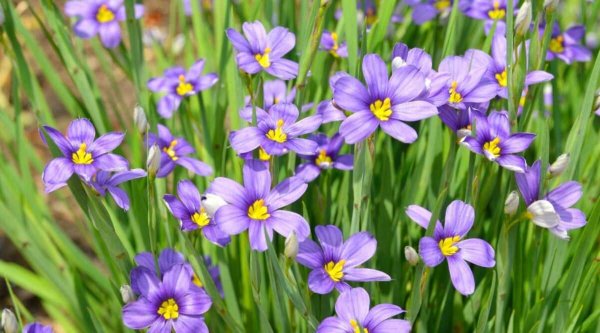
Blue-eyed grass (Sisyrinchium spp.), a North American native, looks like a true grass but is actually a flowering perennial. It grows 1 to 2 feet tall, blooms in spring with purple, blue, or yellow flowers, and does well in partial shade, though it flowers less in lower light.
For a tough, adaptable ground cover, liriope (Liriope spicata), also called monkey grass or mondo grass, is an Asian native that forms dense, evergreen clumps of thin leaves. It grows 0.5 to 1.5 feet tall, tolerates a range of soil conditions, and produces pinkish flower spikes in summer. Plant it closely for a low-traffic lawn substitute or for erosion control on slopes.
Taller Grasses for Privacy and Naturalized Areas
When you need height or a living screen, consider native bamboos. Giant cane (Arundinaria gigantea), also called canebrake bamboo, is a southeastern U.S. native that grows 4 to 20 feet tall. It forms dense, evergreen stands that provide excellent cover for birds and small animals, and it thrives in rich, moist, well-drained soil, though it dislikes prolonged sogginess.
Switch cane (Arundinaria tecta), or small cane, is another native bamboo, growing 6 to 10 feet tall. It tolerates full sun to deep shade and periodic flooding, making it a versatile choice for wetland edges or large naturalized areas. It spreads quickly by rhizomes and serves as a privacy screen.
For a more moderate height, bottlebrush grass (Elymus hystrix) is native to the central and eastern U.S., growing 2 to 4 feet tall in partial shade. Its summer seed heads resemble spiky bottlebrushes, attracting birds. River oats (Chasmanthium latifolium) is another native, reaching 2 to 5 feet, with showy, flattened oat-like seed clusters in late summer and fall. It self-seeds readily and is a larval host for the northern pearly-eye butterfly.
Tussock grass (Deschampsia cespitosa), also known as tufted hair grass, is native to northern North America and forms dense, rounded clumps of thin, bright green leaves. It grows 1.5 to 3 feet tall, prefers cooler conditions, and produces airy panicles in late summer that persist into winter, providing food for birds.
Finally, zig-zag bamboo (Shibataea kumasaca), from China and Japan, is a low-maintenance evergreen that grows 2 to 4 feet tall. Its reddish stems form a distinctive zig-zag pattern, and it spreads slowly, making it suitable as a low hedge or in naturalized areas.
When selecting any ornamental grass, research whether it is invasive in your region. Some species spread aggressively by self-seeding or rhizomes, but many of the options above are slow-growing and well-behaved. For poor soil, raised beds filled with quality soil offer a simple solution, allowing you to grow compact grass varieties even in challenging spots.
With the right choices, shaded areas can become as vibrant and diverse as any sunny border, adding graceful foliage and seasonal interest to your landscape.