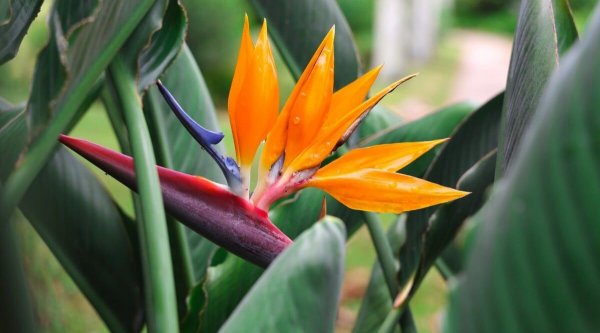
For gardeners seeking a touch of the tropics, few plants deliver as boldly as the bird of paradise. Known botanically as the Strelitzia genus, these five species—ranging from the compact orange crane flower to the towering giant—offer a spectrum of sizes, colors, and climate tolerances. Whether filling a sun-drenched corner indoors or anchoring a subtropical backyard, each variety brings its own character, and understanding their differences is key to success.
The most familiar species, Strelitzia reginae, is a resilient favorite native to South Africa's coastal Cape and Kwa-Zulu Natal provinces. Named by English botanist Joseph Banks in the 18th century, its epithet 'reginae' translates to 'of the queen,' reflecting royal associations. This species typically reaches about 6 feet in height, with upright blue-green leaves that contrast sharply with its striking orange and blue blooms, which appear from late winter into spring. Its adaptability has made it a popular houseplant and an outdoor staple in warm regions like Florida and California, where it holds the distinction of being the Official Flower of the City of Los Angeles. For a subtler palette, the cultivar 'Mandela's Gold' offers yellow flowers instead of orange. The plant thrives with a full day of sun and well-draining soil, though high winds can split its leaves, so a sheltered spot is advisable.
Giant and White Varieties for Bold Statements
For those with ample space, Strelitzia nicolai, the giant bird of paradise, can reach an impressive 30 feet, with large banana-like leaves that create an instant tropical feel. Native to coastal South Africa and also found in Zimbabwe, Mozambique, and Botswana, this species produces white blooms with a deep blue bract, though flowering indoors can be challenging without optimal light. It grows well in full sun or partial shade and requires regular watering, especially after planting. While it is more sensitive to cold than S. reginae, protecting it indoors during winter prevents leaf and root damage, and a sheltered position guards against strong winds that can tear its massive foliage.
Strelitzia alba, also known as Cape wild banana or white bird of paradise, is another tall option, growing between 20 and 30 feet. Its pristine white flowers stand out against arching green foliage, making it ideal for toned-down gardens. The leaves alone can reach 6 feet in height. This species is moderately drought-tolerant once established but responds well to regular watering after planting. It is relatively hardy and can withstand cooler temperatures than some other Strelitzia varieties, though it still requires a warmer zone for year-round outdoor growth.
Specialty Species for Unique Climates
Strelitzia caudata, the mountain strelitzia, originates from high-altitude regions of South Africa, making it well-suited to cooler subtropical climates rather than very warm tropics. Its epithet 'caudata' means 'tailed,' referring to a unique sepal found only in this species. Growing to about 20 feet, it produces white and blue flowers, a color combination rarely seen in gardens. This species prefers partial shade, making it more adaptable to lower light conditions, and benefits from regular watering and protection from strong winds.
Strelitzia juncea, the rush-leaved strelitzia, stands apart with its narrow, reed-like foliage, a departure from the broad leaves of its relatives. Native to parts of the Eastern Cape province, it grows to about 6 feet and has a grassy appearance, making it an excellent choice for smaller spaces or as an architectural accent. Its flowers match the familiar orange and blue of S. reginae. This species thrives in arid environments, tolerating harsh sun and drought, and is well-suited to water-wise gardens.
A Lost Hybrid and Practical Takeaways
One additional entry, Strelitzia × kewensis, is a hybrid of S. reginae and S. alba, first cultivated at Kew in England and flowering in 1909. It produced unique pale yellow flowers but has since disappeared from cultivation, according to Kew, making it unavailable to gardeners.
When selecting a bird of paradise, consider your climate and available space. For compact indoor settings, S. reginae or S. juncea are manageable, while S. nicolai or S. alba can fill larger outdoor areas with dramatic effect. S. caudata offers a cooler-climate option. All species share a love of warmth and well-draining soil, and with proper placement, they can transform a garden or room into a lush, tropical retreat.