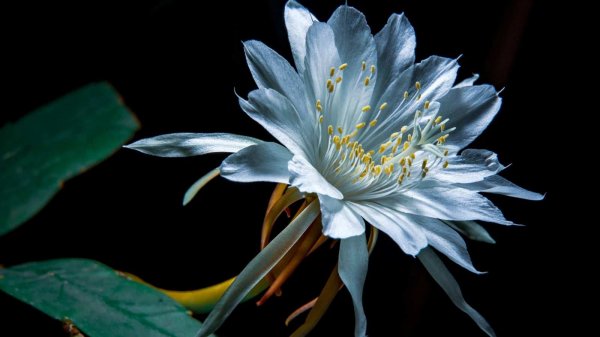
Creating a moon garden indoors is possible with a large window and the right plant choices. Seven species, from the night-blooming cereus to the gardenia, open their flowers after sunset, releasing fragrance and reflecting moonlight. These plants offer a sensory experience for evening hours, whether placed on a windowsill or in a bright corner.
The concept of a moon garden traditionally involves outdoor spaces designed to shine under moonlight, using silver foliage and white blossoms. Indoors, the challenge is providing enough light and humidity, but many species adapt well to container life. The following plants are known for their nocturnal blooming habits and are suitable for indoor cultivation with proper care.
Night-Blooming Cereus and Queen of the Night
The night-blooming cereus, which includes Selenicereus grandiflorus and Hylocereus undatus, is a succulent that blooms in the evening, typically once a year until mature. It requires full sun to partial shade and can grow from 3 to 20 feet tall, with hardiness zones 10-12. Another similar plant, the Queen of the Night (Epiphyllum oxypetalum), also known as orchid cactus, produces large, fragrant flowers for a single evening. It thrives in full sun to partial shade, reaches 8-10 feet, and prefers higher humidity, making a bathroom an ideal spot.
Night Fragrant Orchid and Jasmine
The night fragrant orchid (Epidendrum nocturnum) is native to Florida, the West Indies, and parts of Central and South America. In Florida, it is on the endangered plant list, and collecting it from the wild is illegal, but it can be purchased from breeders. This orchid blooms between late fall and early spring, opening in the evening with a pleasant fragrance. It prefers bright indirect light and grows to about 3 feet tall, with hardiness zones 10-11.
Night-blooming jasmine (Cestrum nocturnum), despite its name, is not a true jasmine. It is an evergreen that can climb with a trellis and produces clusters of tiny white blossoms in summer that open at night and close by morning. The plant grows 8-10 feet tall, prefers full sun to partial shade, and is hardy in zones 9-11. Its berries are poisonous to animals and humans, so they should be removed.
Night Phlox and Gardenia
Night phlox (Zaluzianskya ovata), a small shrub from South Africa, grows to about 20 inches tall and opens a mass of small, white flowers in the dark, releasing an intoxicating fragrance. It prefers full sun to partial shade, is hardy in zones 8-11, and has slightly sticky foliage. This plant is not related to true phloxes.
Gardenia (Gardenia jasminoides) is a classic shrub that blooms in the evening, releasing its notorious fragrance. It prefers bright indirect light, grows 3-4 feet tall, and is hardy in zones 8-12. Unlike many night bloomers, gardenia flowers remain open for several days, with the most fragrance released around dusk. They prefer warm, humid spaces but can tolerate sub-freezing temperatures.
Easter Lily Cactus
The Easter lily cactus (Echinopsis oxygona) is native to South America, growing in rocky areas and forests. It is short and rounded with deep ribbing and short, black spines, and it can be mat-forming over time. This cactus blooms throughout the summer, producing up to a dozen white or pink flowers at a time, which open in the dark. It requires full sun, grows to only 2-3 inches tall, and is hardy in zones 8-11.
For those interested in an indoor moon garden, these seven plants offer a range of forms and fragrances. While some, like the cereus, may have a modest appearance for most of the year, their night-time blooms provide a unique spectacle. With attention to light and humidity, these plants can bring the magic of a moon garden indoors.