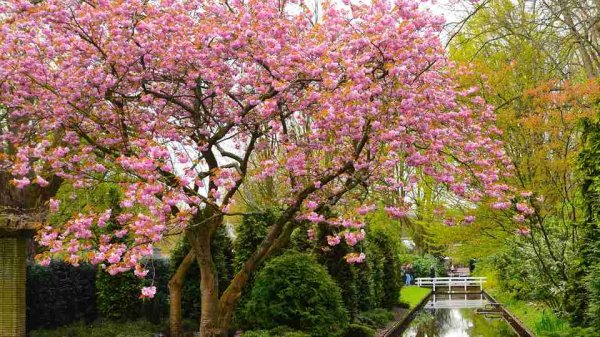
When it comes to spring spectacle, few trees rival the flowering cherry. These ornamental trees, known for their profuse blossoms, also contribute structure and seasonal interest to landscapes throughout the year. However, they require specific growing conditions—adequate sunlight, well-drained soil, and regular moisture—to perform at their best. For gardeners willing to meet these needs, the payoff is a stunning display that marks the season's turn.
Among the most recognized is the 'Yoshino' cherry (Prunus x yedoensis), a large tree reaching 30 to 40 feet tall, hardy in zones 5-8. Its fragrant white blooms, sometimes blushed with pink, appear in clusters as the leaves emerge. This cultivar thrives in full sun to partial shade and is notably tolerant of various soil types, though it does not withstand drought. The 'Yoshino' is famously planted around Washington D.C.'s Tidal Basin, a testament to its ornamental value and adaptability. Its small, bitter fruit, while not for human consumption, provides food for birds, and its fall foliage turns yellow with bronze hints.
Another popular choice is the 'Kwanzan' cherry (Prunus serrulata 'Kanzan'), which grows 25 to 30 feet tall in zones 5-9. It features an upright, vase-shaped habit and produces an abundance of large, double-petaled blossoms that hang in pendulous clusters, facing downward—an inviting canopy for sitting beneath. While it is a prolific bloomer, it has a relatively short lifespan and is susceptible to several pests, requiring some vigilance.
Heat-Tolerant and Compact Varieties
For warmer climates, the 'Okame' cherry (Prunus x incam 'Okame') stands out. This hybrid, a gift from Japan to Washington D.C. in the early 1900s, is more heat-tolerant than many other flowering cherries and is relatively easy to care for. It grows 15 to 30 feet tall, with bubblegum pink, lightly fragrant flowers that cover the bare branches before foliage appears. It is grafted onto rootstock, so gardeners should remove any suckers that emerge from the base.
For smaller spaces, weeping cherries offer a graceful option. 'Pendula Plena Rosea' (Prunus pendula 'Pendula Plena Rosea') reaches 15 to 25 feet, with cascading branches and double blossoms in white or blush pink. It is also valued for its golden autumn leaves. 'Snow Fountains' (Prunus x 'Snofozam') is a compact weeping variety, growing only 8 to 15 feet tall, making it ideal for small gardens or as a focal point. Its pure white flowers create a fountain-like effect, and its fall color ranges from orange to gold.
Unique Bloom Times and Forms
Some cherries offer extended seasons of interest. 'Autumnalis' (Prunus x subhirtella 'Autumnalis') is notable for its repeat blooming—it flowers in the fall and again in flushes through winter and early spring. This tree, growing 20 to 30 feet tall in zones 6-8, has a delicate, domed shape and produces blush to nearly white blossoms from pink buds. It is among the longer-lived cherry varieties.
For a tree with a distinctive columnar form, 'Amanogawa' (Prunus serrulata 'Amanogawa') is a standout. It grows 20 to 25 feet tall but rarely spreads more than 8 feet wide, making it perfect for narrow spaces. Its upward-facing, blush-pink flowers are fragrant and densely packed along the branches.
Other award-winning cultivars include 'Accolade' (Prunus x 'Accolade'), which blooms early with fluffy, powder-pink flowers in dense clusters, and 'Mount Fuji' (Prunus serrulata 'Mount Fuji'), known for its fragrant white double blossoms that open from pink buds, resembling a snow cover. 'Tai-Haku' (Prunus serrulata 'Tai-Haku') boasts the largest flowers among ornamental cherries, with pure white blooms up to 2.5 inches across, set against bronze-tinted new foliage. 'Shiro-Fugen' (Prunus serrulata 'Shiro-Fugen') is a late bloomer with fluffy white-to-pale-pink flowers in dense clusters, and it has a long cultivation history in Japan. 'Kiku-Shidare-Zakura' (Prunus serrulata 'Kiku-Shidare-Zakura'), meaning 'Weeping Chrysanthemum Cherry,' is a compact weeping tree with blossoms containing up to 125 petals each. Finally, 'Shogetsu' (Prunus serrulata 'Shogetsu') offers large, fluffy clusters of white-to-blush flowers that hang pendulously, creating a breathtaking view from beneath.
When selecting a flowering cherry, consider the tree's mature size, bloom time, and local climate. Most prefer full sun to partial shade and well-drained soil. With proper placement and care, these trees can provide decades of spring beauty.