Gardeners looking to line a walkway or edge a bed with native plants often find that many popular species grow too tall. However, a number of native perennials stay under two feet, offering colorful blooms and foliage without towering over paths. These compact plants support local wildlife and thrive in a range of conditions, from sunny prairies to shaded woodlands.
Among the earliest bloomers is the American pasque flower (Pulsatilla nuttalliana), which emerges in spring in the Northern Plains. Its purple petals and bright yellow centers appear before the leaves, and after pollination, it produces spherical, silvery seed heads. This species prefers well-drained soil and does not compete well with taller neighbors.
Another low-growing option is pussytoes (Antennaria plantaginifolia), native to much of the eastern United States. Its velvety green leaves form dense mats that suppress weeds, and in spring it sends up stems topped with rounded white flowers resembling cat's toes. It grows in most sunny to partially shaded spots with well-draining soil.
For shaded areas, green and gold (Chrysogonum virginianum) stays just a few inches tall and produces bright yellow flowers in summer and again in fall. It spreads moderately and is ideal for filling gaps between pavers or along wooded edges, provided the soil is moist but well-drained.
Butterfly weed (Asclepias tuberosa) is a milkweed that reaches up to two feet and is a key food source for monarch caterpillars. Its orange blossoms attract pollinators, and it thrives in dry, sunny spots. It has a long taproot that helps it withstand drought, though seedlings need regular water initially.
Harebell (Campanula rotundifolia) offers delicate purple bell-shaped flowers on slender stems from summer into fall. It blooms sporadically, so planting a large patch increases the chance of continuous color. This perennial tolerates varied conditions, from rocky cliffs to coarse beaches.
Prairie smoke (Geum triflorum) blooms in late spring with pink, hibiscus-like flowers that develop feathery, silvery seed heads. It prefers dry soil and full sun, making it suitable for rock gardens. In partial shade, it produces fewer flowers.
Dwarf blazing star (Liatris cylindracea) is the shortest of the blazing stars, with slender leaves and light purple, feathery flower heads from midsummer to fall. It thrives in sunny, well-drained areas and tolerates moderate drought once established.
Wild blue phlox (Phlox divaricata) grows on shaded forest floors in the eastern U.S. It forms clumps of lance-shaped leaves and produces clusters of five-petaled periwinkle flowers in spring, with some varieties offering white or pink blooms. It prefers well-draining soil in partial to full shade.
Common blue-eyed grass (Sisyrinchium albidum) is not a true grass but a relative of irises. It has star-shaped blue flowers with yellow centers that open in the morning and close later in the day. This species grows from rhizomes and can form large patches in sunny, well-drained areas.
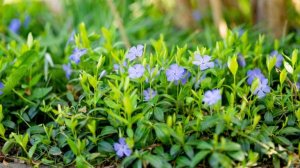
Common blue violet (Viola sororia) is often dismissed as a weed but is a valuable native. It adapts to various light and soil conditions and provides early spring nectar for insects. Its purple blooms add color to lawns and gardens.
Dwarf crested iris (Iris cristata) remains under a foot tall and features large purple flowers with cream and yellow accents. It spreads via rhizomes and makes an excellent ground cover for woodland gardens, though it needs more water in sunnier spots.
Big-leaved aster (Eurybia macrophylla) grows up to three feet, making it one of the taller short plants. Its large leaves and star-shaped fall blooms are ideal for compact spaces. It tolerates various light and moisture levels and can act as a flowering ground cover.
Prairie onion (Allium stellatum) produces spherical clusters of light purple flowers on arching stems in summer. It prefers dry, well-draining soil and is suited to rock gardens. Note that it is listed as noxious in some states due to its effect on grazing livestock, though it is generally safe in gardens.
Downy wood mint (Blephilia ciliata) is a spreading perennial with square stems and clusters of small purple flowers in summer. It grows well in dry to semi-moist areas with some sun and is native to the eastern U.S. It forms clumps without being invasive.
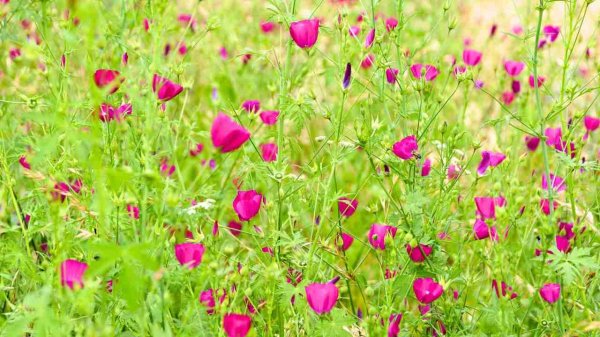
Purple poppy mallow (Callirhoe involucrata) has cup-shaped magenta flowers that bloom from late spring through summer. It thrives in dry, sunny areas and can sprawl a few feet across, making it a beautiful ground cover in poor or rocky soil.
These 15 native perennials offer a range of colors, bloom times, and growing conditions, allowing gardeners to create attractive edges and front beds that support local ecosystems. Whether for a sunny border or a shaded path, there is a compact native option to suit the space.